Is your beekeeping hobby becoming a source of anxiety rather than a peaceful retreat? Many UK beekeepers tolerate defensive colonies because they believe aggressive "follow-me" behaviour is simply an unavoidable part of the craft. This is a misconception. Colony temperament is a management choice, and selecting the right gentle honey bee breeds UK is the most effective way to guarantee a manageable apiary. Whether you're worried about hostile inspections or upsetting neighbours in a residential area, the solution starts with superior genetics rather than heavy smoking.
We understand that you want a productive hive without the conflict. It's a common concern for hobbyists who want to enjoy their garden without fear of stings. This guide will help you discover the best gentle honey bee breeds for UK apiaries and teach you how to maintain a calm, productive colony through expert breed selection. We'll examine why F1 Buckfast and Carniolan queens remain the industry standards for 2026, how they perform in British National hives, and the steps you can take to secure high-quality stock for a successful, stress-free harvest.
Key Takeaways
- Learn how selecting gentle honey bee breeds UK ensures a manageable apiary that is safe for urban gardens and nearby neighbours.
- Compare the productivity and overwintering strengths of F1 Buckfast and Carniolan bees to find the perfect fit for your local environment.
- Discover why regular requeening with verified F1 genetics is essential to maintain a calm temperament and prevent aggressive traits from emerging.
- Understand the risks of unverified bee sources and why starting with a high-quality nucleus colony is the most reliable path to a successful honey harvest.
- Learn how professional breed selection reduces the need for heavy smoking and allows for more frequent, stress-free hive inspections.
Why Colony Temperament is Critical for UK Beekeeping
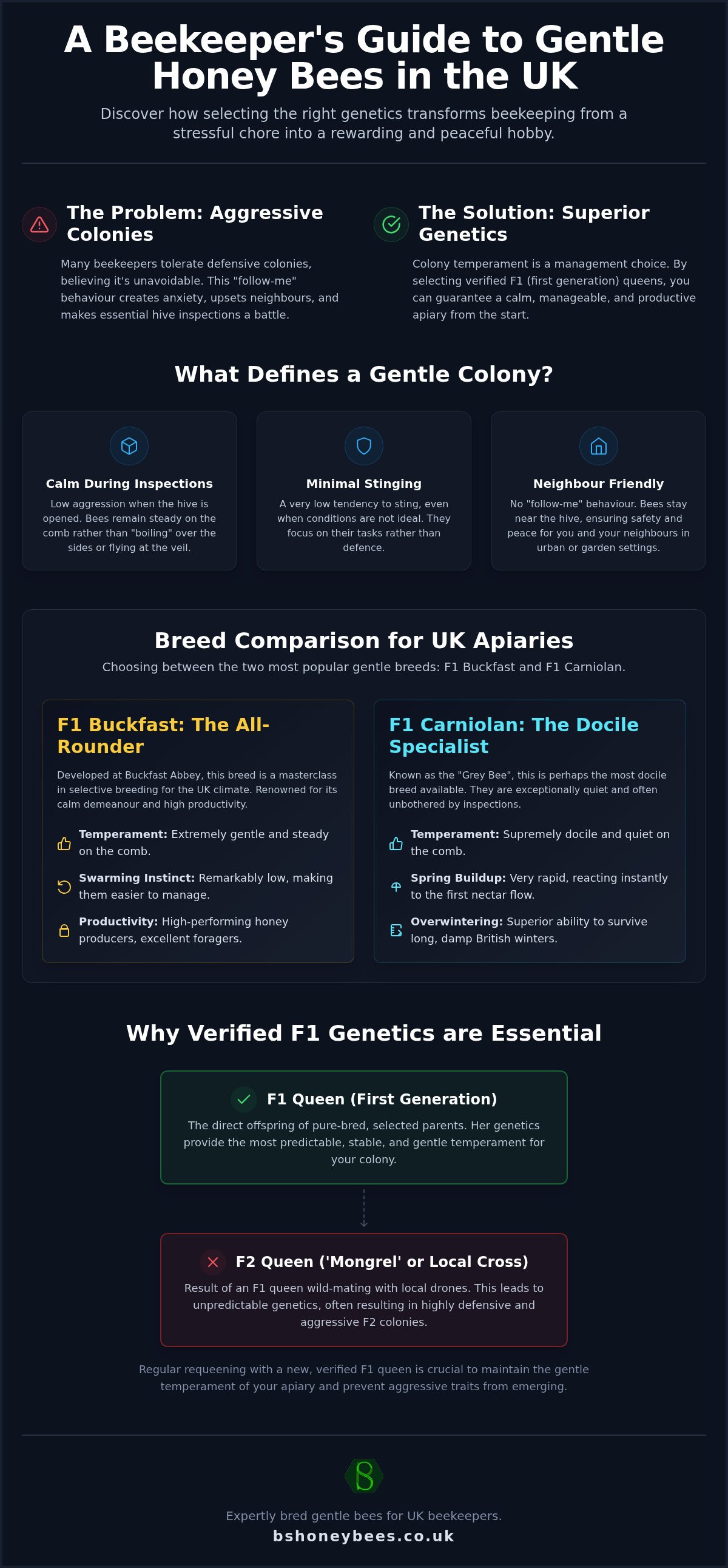
For many UK beekeepers, the difference between a rewarding hobby and a stressful chore comes down to a single factor: temperament. Selecting gentle honey bee breeds UK is not just a preference; it's a fundamental requirement for modern beekeeping in a densely populated country. Gentleness is defined by three specific traits. First, low aggression during hive openings. Second, bees that remain steady on the comb rather than "boiling" over the sides or flying at the veil. Finally, a minimal tendency to sting, even when environmental conditions are less than ideal.
Maintaining calm colonies is a matter of social responsibility. With many apiaries situated in urban gardens or on local allotments, aggressive bees are a liability. A colony that displays "follow-me" behaviour, where guard bees pursue people long after a hive is closed, can quickly lead to friction with neighbours. Choosing manageable genetics is the only way to ensure beekeeping remains a welcome addition to the community. It also ensures you can perform essential health checks without the distraction of a hostile environment.
The Problem with "Mongrel" or Local Bees
There is a common misconception that "local bees" are inherently better. While local adaptation has its place, unmanaged wild-mating often results in "mongrel" colonies with unpredictable traits. These second-generation (F2) crosses frequently develop high defensive responses. Genetics dictate how guard bees react. if a queen mates with drones from hostile local lines, the resulting workers will be significantly more reactive. This unpredictability makes it difficult to plan inspections and increases the risk of being chased away from your own apiary.
Benefits of Managing Gentle Breeds
Opting for established lines like the Buckfast bee transforms hive management. When bees stay calm on the frames, queen spotting is simple. Beginners build confidence faster without the constant threat of stings or the need for excessive smoke.
- Accurate disease and health inspections.
- Lower stress for both the colony and the beekeeper.
- Successful management in residential or public areas.
- Increased focus on productivity rather than hive defence.
Ultimately, a gentle apiary is a productive apiary. By prioritising temperament, you ensure that every visit to the hive is an educational experience rather than a battle of wills.
The Top Gentle Honey Bee Breeds for British Apiaries
The queen is the genetic engine of the colony. Her DNA dictates every aspect of the hive's behaviour, from forage range to defensive response. For those seeking gentle honey bee breeds UK, the focus must remain on F1 (first generation) queens. These are the direct offspring of pure-bred, selected parents. They offer the most predictable and stable temperament available to the modern beekeeper. Whilst some global breeds like the Italian (Ligustica) are popular in warmer climates, they often struggle with the damp, unpredictable British winters. Success in our region requires bees that are both docile and hardy.
Most UK hobbyists and commercial operators find that these selected breeds thrive best in British National beehives. This hive standard is perfectly sized for the brood patterns of refined breeds. When you are sourcing quality gentle bees, it is vital to select a specialist who prioritises temperament. A calm hive is a manageable hive; it allows you to work with precision and efficiency.
F1 Buckfast Queens: The All-Rounder
Originally developed by Brother Adam at Buckfast Abbey, the Buckfast bee is a masterclass in selective breeding. These bees are specifically adapted for the British environment. They are legendary for their extreme gentleness and remarkably low swarming instinct. They are a "no-nonsense" bee. They remain steady on the comb during inspections and rarely take flight when a frame is lifted. Choosing F1 Buckfast queens UK ensures you receive these refined genetics before they are diluted by local wild mating. They are high-performing honey producers that stay calm under pressure.
Carniolan Bees (Apis mellifera carnica)
Often referred to as the "Grey Bee", the Carniolan is perhaps the most docile breed currently available in the UK. They are exceptionally quiet on the comb. It is common for Carniolans to continue their work entirely unbothered whilst a beekeeper conducts a full health check. Their primary strength lies in their rapid spring buildup. They react instantly to the first signs of nectar, which is critical for making the most of the short UK forage seasons. They also possess superior overwintering capabilities, often surviving on fewer stores than other breeds by tightly regulating their winter cluster.
Selecting the right strain is the most important decision you will make this season. You can browse our current range of F1 Buckfast and Carniolan queens to ensure your apiary remains a peaceful and productive environment.
Buckfast vs Carniolan Bees: Which is Right for You?
Choosing between these two powerhouses depends on your specific goals and the time you can dedicate to your apiary. While both are considered premier gentle honey bee breeds UK, their biological strategies differ significantly. Buckfast bees are the engine of the commercial world; they are bred to build immense populations that can capitalise on every major nectar flow. In contrast, Carniolans are the survival specialists, balancing their population against available resources with surgical precision. Understanding these differences is the key to a stress-free season.
Forage and Productivity Comparison
Buckfast bees are renowned for their relentless foraging drive. They excel in areas with diverse forage and are the top choice for beekeepers prioritising large-scale honey production. However, because they maintain large brood nests throughout the season, they require significant food stores. You must ensure they are well-fed during lean periods. Carniolan bees take a more conservative approach. They are exceptionally thrifty with their stores, making them highly resilient during the "June gap" when forage can suddenly become scarce across the UK countryside.
When it comes to organising the brood nest for the UK winter, Carniolans are arguably more efficient for northern or exposed regions. They reduce their population quickly as the temperature drops, entering a tight, energy-efficient cluster. Buckfast colonies tend to maintain a larger cluster, which requires more winter fuel. If you live in an area with long, harsh winters, the Carniolan’s ability to survive on minimal stores is a distinct advantage.
Management Requirements
Your choice should also reflect your weekly schedule. Buckfast bees were specifically refined to have a low swarming instinct. This makes them ideal for beekeepers with busy professional lives who cannot always perform rigid, weekly inspections during the peak of summer. They are a reliable breed that stays put, provided they have enough space to expand in their hive.
Carniolan bees require a more attentive hand. Their explosive spring buildup is a double-edged sword; if their space isn't managed with precision, they will swarm. This breed is better suited to beekeepers who enjoy the hands-on aspect of swarm control and have the time for vigilant checks. If you can stay ahead of their natural instincts, the reward is an incredibly docile colony that is a genuine joy to handle during every inspection.
For a deeper dive into these nuances, see our full guide on Buckfast vs Carniolan bees to decide which genetics fit your apiary management style best.
How to Maintain a Gentle Apiary Through Requeening
Gentleness in a hive is not a "set and forget" feature. Even when you start with the best gentle honey bee breeds UK, the biology of the hive can lead to a shift in temperament over time. This usually happens during supersedure, when the colony raises its own replacement queen. This new queen will mate with local drones of unknown heritage, often introducing defensive traits into the worker population within just a few generations. To maintain a truly calm apiary, you must take a proactive approach to genetic management through regular requeening with verified F1 stock.
F1 genetics provide the most predictable results for temperament and productivity. When a colony is left to its own devices, the resulting F2 or "mongrel" bees often prioritise hive defence over honey collection. This makes inspections difficult and increases the risk of stings for the beekeeper and the public. Maintaining a high standard of gentleness requires a commitment to replacing queens every two years, or sooner if the colony's behaviour begins to sour.
Identifying Signs of Aggression
It is essential to distinguish between temporary irritability and true genetic aggression. Bees are often grumpy during a nectar dearth or in thundery weather. However, if a colony consistently displays "follow-me" behaviour on clear, sunny days, the genetics have likely shifted. A failing queen produces weaker pheromones, which can cause the colony to feel queenless and more defensive. If you find yourself being stung through your suit or chased away from the hive, the "sting test" has failed. It is time to intervene. A calm colony is not just a luxury; it is easier to inspect for notifiable diseases like European Foulbrood (EFB), ensuring your apiary stays healthy and legal.
The Requeening Process
Successful requeening requires precision and a methodical approach. First, you must identify and remove the old queen. If she remains in the hive, the workers will instinctively reject and kill the new arrival. Once the hive is queenless, wait a few hours before introducing the new mated queen in a protective cage. This short interval allows the colony to realise they are queenless, making them far more receptive to a new leader. Selecting a queen from a specialist breeder ensures you are reintroducing stable, refined genetics rather than gambling with local crosses.
Timing is everything. The best time for requeening in the UK is typically during the mid-summer nectar flow when the bees are well-fed and naturally less defensive. A successful introduction will result in a completely new population of gentle workers within six to eight weeks. If you have noticed your colony becoming difficult to manage, don't wait for a disaster to occur. You can order F1 Buckfast or Carniolan queens today to restore peace and order to your apiary.
Sourcing Quality Gentle Bees and Equipment in the UK
Sourcing your first colony is the most critical decision in your beekeeping journey. While it may be tempting to accept a "free" swarm or buy from unverified local sources, you often inherit aggressive traits and unknown health issues. To guarantee you are working with gentle honey bee breeds UK, you must source from professional breeders who prioritise genetic stability. At BS Honey Bees, we subject every F1 Buckfast and Carniolan queen to rigorous temperament checks before they are dispatched. This methodical approach ensures your apiary remains a safe and productive environment from day one.
Logistical precision is just as important as genetics. Buying from a specialist ensures that your bees have been raised according to strict industry standards. This reduces the risk of introducing notifiable diseases and ensures the temperament of the workers is predictable. When you invest in quality stock, you aren't just buying bees; you're buying the peace of mind that comes with a manageable and docile colony.
Choosing Your Starter Colony
A 5 or 6 frame nucleus colony (nuc) is the gold standard for beginners. Unlike a package of bees, which is simply a box of workers and a queen, a nuc is a functioning miniature colony. It contains a laying queen, brood in all stages, and sufficient food stores. This established structure significantly reduces colony stress and leads to a much higher success rate in the first year. When searching for honey bee nucs for sale UK, look for suppliers who offer nationwide delivery with live-arrival guarantees. We ensure our bees are transported in secure, ventilated containers to maintain their calm temperament during transit.
Essential Gear for Calm Beekeeping
Confidence in the apiary is built on two pillars: gentle bees and reliable protection. Even with the calmest breeds, accidents happen. We recommend BBWear bee suits for their industry-leading protection and comfort. Having a suit you trust allows you to work slowly and methodically, which in turn keeps the bees calm. Beyond the suit, select high-quality hive tools and smokers that allow for precise movements. Avoid clunky, cheap equipment that might cause you to jar the frames or crush bees, as this can trigger a defensive response even in docile colonies.
A peaceful first season is the result of combining superior gentle honey bee breeds UK with the right tools and a disciplined management style. Focus on logistical precision, and your hobby will remain a rewarding, lifelong pursuit. By starting with the right genetics and the right gear, you're setting yourself up for a successful honey harvest without the stress of aggressive behaviour.
Secure a Peaceful Future for Your Apiary
We've established that a manageable apiary isn't a matter of luck; it's the direct result of deliberate genetic selection. By choosing gentle honey bee breeds UK, such as the F1 Buckfast or Carniolan, you transform your weekly inspections from a source of anxiety into a peaceful, educational retreat. These breeds offer the stability and docility required for modern beekeeping, particularly in urban environments where social responsibility is paramount. Maintaining this standard through regular requeening ensures your colonies remain productive and approachable for years to come.
BS Honey Bees Ltd is a dedicated partner for beekeepers seeking excellence. As specialist F1 queen breeders trusted by UK beekeepers since 2026, we provide nationwide live bee delivery to ensure your season starts on the right foot. Order your F1 Buckfast or Carniolan bees today for a gentler apiary. Don't let defensive behaviour dampen your passion for the craft. Take the next step toward a stress-free hobby and enjoy the rewarding experience of managing a truly calm and productive colony.
Frequently Asked Questions
Which honey bee breed is the absolute gentlest for a UK garden?
Carniolan bees are widely considered the absolute gentlest breed for a UK garden due to their exceptionally docile nature and quietness on the comb. They often continue their work entirely unbothered during hive inspections. F1 Buckfast bees are also a premier choice for gentle honey bee breeds UK, offering a reliable balance of calm temperament and high productivity that suits residential areas perfectly.
Do gentle bees produce less honey than more aggressive breeds?
Gentle breeds do not produce less honey; in fact, they are often significantly more productive than aggressive "mongrel" colonies. Breeds like the F1 Buckfast have been specifically selected for their high honey yields alongside their manageable temperament. Because these bees are easier to handle, you can perform more thorough health checks and ensure the colony remains focused on foraging rather than hive defence.
Can I keep Buckfast and Carniolan bees in the same apiary?
You can certainly keep Buckfast and Carniolan bees in the same apiary without any conflict between the colonies. Each hive operates independently, though you must remain mindful of their differing management requirements. For instance, your Carniolan hives may require more frequent swarm checks in the spring, whilst your Buckfast colonies might need more attention regarding their food stores during a mid-summer nectar dearth.
Why have my previously gentle bees suddenly become aggressive?
Sudden aggression is usually caused by a change in the colony's genetics or environmental stress. If your bees were previously calm, they may have raised a new queen that mated with defensive local drones, or the colony could be currently queenless. External factors such as thundery weather or a sudden nectar dearth can also cause temporary irritability, which is distinct from permanent genetic aggression.
How often should I requeen to keep my bees calm?
We recommend requeening every one to two years to maintain the calm temperament and high productivity of gentle honey bee breeds UK. As a queen ages, her pheromones weaken and the risk of the colony raising a replacement increases. By proactively introducing a fresh F1 queen, you ensure the hive's genetics remain stable and prevent the emergence of defensive traits associated with wild-mated crosses.
Is it safe to keep honey bees near children and pets in the UK?
Keeping honey bees near children and pets is safe provided you select gentle breeds and position the hives correctly. By using F1 Buckfast or Carniolan stock, you minimise the risk of defensive behaviour in your garden. Ensure the hive entrance faces away from high-traffic areas or install a six-foot screen to force the bees' flight path above head height, keeping the area safe for everyone.
What is the best time of year to buy a gentle nucleus colony?
The best time to buy a gentle nucleus colony is in late spring or early summer, typically between May and June. This timing allows the colony to establish itself and build up stores before the winter. Many beekeepers choose to pre-order their nucs in the autumn or winter to ensure they receive high-quality F1 stock as soon as the following season begins in May.
Do I need a different type of hive for Carniolan bees?
You don't need a different type of hive for Carniolan bees; they thrive in the standard British National hive. Whilst they are native to Central Europe, they adapt perfectly to the UK's hive standards and climate. Their efficient brood patterns and thrifty use of stores make them well-suited to the size and thermal properties of both timber and poly National hives used across the country.