A bee smoker should produce cool, dense smoke, not a fierce flame. To learn how to light a bee smoker, ignite crumpled paper in the firebox, pump the bellows until it catches, then add dry fuel gradually without packing it down.
Getting the fire established is only part of the job. Smoke can mask bees’ alarm pheromone and help reduce disturbance during hive work, so it matters how you apply it as well as how you keep the smoker alight.
This guide explains how to prepare and light a smoker, maintain a steady supply of smoke, and use it gently around the hive. You’ll also learn how to keep the smoker upright while working, then extinguish and store it safely when you’re finished.
Key Takeaways
- Build a steady fire with dry, non-toxic fuel, adding it gradually rather than packing it tightly.
- Use light puffs of smoke around bees and at the hive entrance, rather than directing a heavy cloud onto them.
- Keep the smoker upright while you work to help prevent it tipping or going out.
- Choose a safe way to extinguish it: empty the contents into a fire-safe place and douse them with water, or restrict the air supply and lay the smoker on a non-flammable surface.
- Once it’s out, leave the smoker clear of combustible materials and store it safely with the lid open.
Extinguishing and storing the smoker
Plan how you’ll extinguish the smoker before finishing work, and keep it away from anything combustible. Local restrictions may apply to outdoor fires, so check applicable notices before lighting a smoker.
Take account of fire risks
- Choose a safe place for the smoker. Keep it upright and away from dry grass, leaves, timber and other combustible materials while it’s alight. Never leave a lit smoker on a beehive or where it could fall over and open. Don’t leave it in an enclosed space such as a shed, garage, house, barn or car, or in the load bed of a pickup truck. A tip or stray ember can start a fire.
Extinguish the smoker after use
- Put the smoker out before carrying or storing it. One method is to empty its contents into a fire-safe container or fire pit, then douse them thoroughly with plenty of water. Treat the fuel and ash as hot until fully extinguished. Don’t discard them on soil, grass or in household waste while they could still smoulder.
- Alternatively, cut off the air supply. Plug the spout to restrict oxygen, then lay the smoker on its side on a flat, non-flammable surface. Grass or similar material can help plug the nozzle. Keep the smoker away from combustible materials, and don’t assume it’s out just because smoke has stopped; fuel inside may continue to smoulder.
Store the smoker safely
- Clear the firebox and leave the lid open. When finished using it, empty the smoker into a fire-safe container and leave its lid open to reduce residue build-up. Check the firebox and nozzle for leftover fuel before putting the smoker away. Don’t store it with hot ash or partly burnt fuel inside.
- Let the smoker cool in a safe position. Keep it on a stable, non-flammable surface until the metal and contents are cool. Avoid placing it in a shed, garage, house or vehicle while it’s still hot or smoking. Once cool and empty, store it where it cannot tip onto dry vegetation or other combustible materials.
- Deal with residue before the next use. Ash and burnt fuel left in the firebox can obstruct airflow or spill when the smoker is moved. Clear out debris after each session, and check that the spout is unobstructed before lighting it again. A clean, empty smoker is easier to position and handle safely.
How smoke masks bees’ alarm pheromone
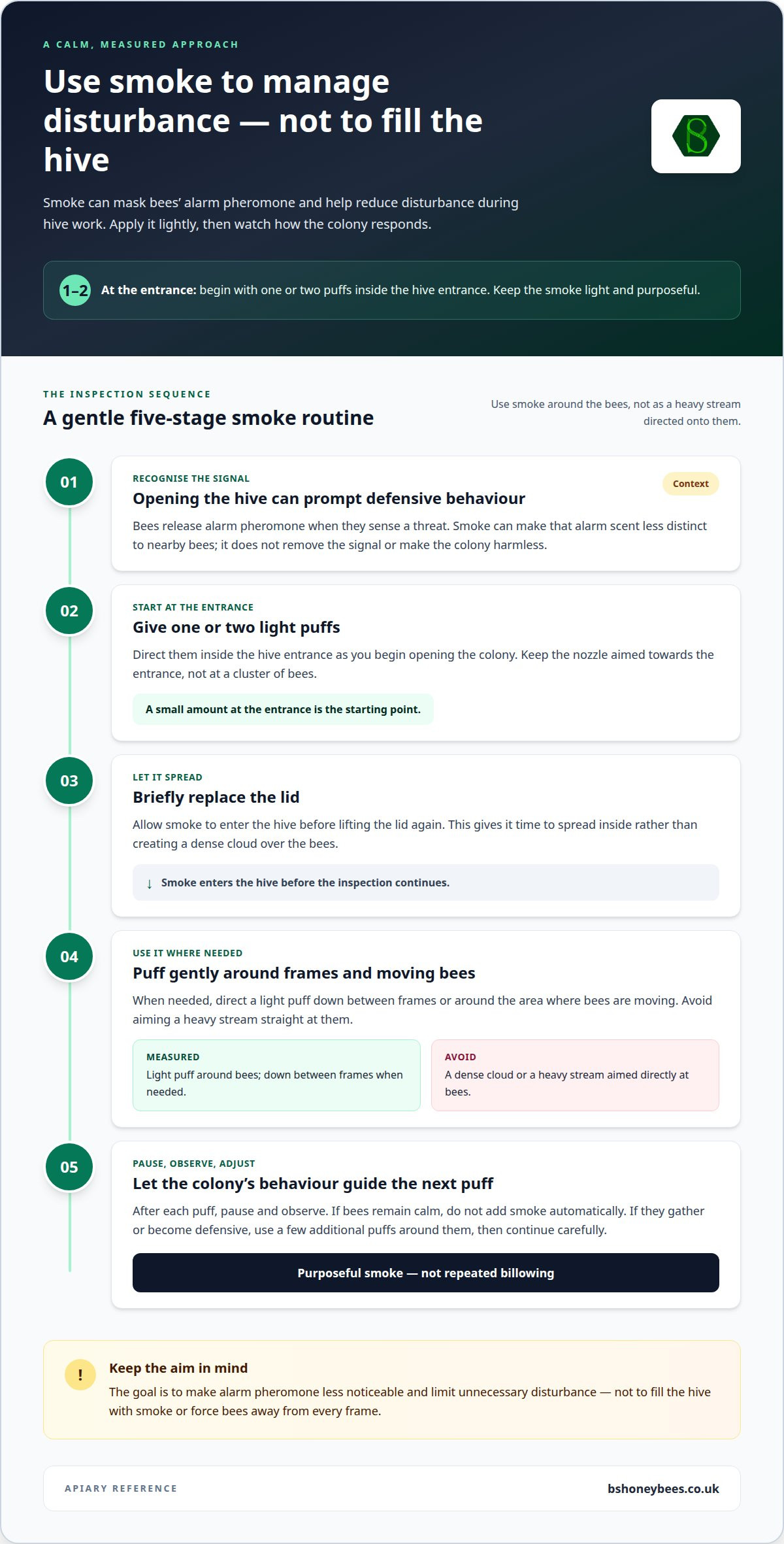
Use smoke sparingly during hive work: it can mask bees’ alarm pheromone and help reduce disturbance.
- Recognise the alarm signal. Bees release alarm pheromone when they sense a threat, helping alert other bees nearby. During an inspection, opening the hive and moving frames can prompt defensive behaviour. Smoke can mask that alarm scent, making it less distinct to bees. It doesn’t remove the signal or make the colony harmless, so work calmly and keep smoke light.
- Apply a small amount at the entrance. Direct one or two puffs inside the hive entrance when you begin opening the colony. Briefly replace the lid, allowing smoke to enter before lifting it again. This gives smoke time to spread inside rather than creating a dense cloud over the bees. Keep the nozzle directed towards the entrance, not at a cluster of bees.
- Use smoke around bees, not directly onto them. Puff gently around the frames or the area where bees are moving. A heavy stream aimed straight at the bees can disturb them rather than help you manage the inspection. As you work, direct smoke down between frames when needed. Pause after each puff and observe the colony’s behaviour before deciding whether more smoke is useful.
- Adjust your approach as you inspect. Lift frames steadily and watch for bees gathering or becoming defensive. If their behaviour changes, use a few additional puffs around them, then continue carefully. Avoid repeatedly billowing smoke without a reason. The aim is to keep alarm pheromone less noticeable, not to fill the hive with smoke or force bees away from every frame.
- Keep smoke purposeful throughout the inspection. Use it at the entrance when opening the hive, then only where the work calls for it. If bees remain calm, avoid adding smoke automatically. If you need to inspect a particular frame, direct a light puff down between frames rather than onto the bees. This measured pattern helps you work inside the hive while limiting unnecessary disturbance.
Keeping the smoker upright while working
Keep the smoker upright during hive work. If it tips onto its side, it may go out, leaving you without smoke when you need it.
- Set it upright before opening the hive. Choose a stable position close enough to reach during the inspection. Keep the smoker standing rather than resting it on its side between tasks. A secure upright position helps the fire continue burning and lets you use the bellows when smoke is needed.
- Keep it within reach, but out of your working path. Place it where you can pick it up without leaning across open frames or moving equipment. For example, position it beside your work area, not on the hive lid. That way, you can reach the smoker while keeping your hands and attention on the inspection.
- Return it upright after every puff. Hold the smoker steady as you apply smoke, then put it back in its standing position straight away. Avoid setting it down on its side while you lift a frame or adjust the hive. Repeating this simple movement helps prevent an accidental tip during routine tasks.
- Make upright placement part of each pause. Before handling a frame, tool or hive component, settle the smoker first. If you need both hands, pause and return the smoker to its upright position before continuing. This is especially useful when moving between frames, where a brief distraction can leave the smoker knocked over.
- Check its position as the inspection progresses. Each time you change position around the hive, look at where the smoker is standing. Keep it upright rather than dragging it by the bellows or leaving it behind you. If your working space changes, move it carefully and set it upright again before using smoke.
- Watch for signs that it has tipped or gone out. If the smoker is lying on its side, stand it upright before deciding whether it is still producing smoke. Check the spout for a visible stream when you use the bellows. If smoke has stopped, don’t assume that pumping alone will restore it; the fire may need attention before you continue.
- Keep the upright habit consistent. Treat every pause as a prompt to return the smoker to a steady standing position. This includes moments when you replace the hive lid, inspect a frame or reach for a tool. Keeping it upright helps it remain ready, rather than discovering it has gone out midway through the inspection.
Lighting and maintaining a bee smoker
- Inspect the smoker before lighting it. Check that the bellows don’t leak and that the air holes and tubes are clear and aligned. With the lid closed, pump the bellows and confirm a strong current of air comes from the nozzle. Take matches or another way to light it when you go to the bees. Learning how to light a bee smoker starts with making sure air can move through it.
- Select dry, non-toxic fuel. Suitable materials include hay, dried grass, touchwood, fir cones and leaves. Paper, newspaper or a paper egg carton can help start the fire. Dry fine-cut wood mulch fully before use, and avoid large chunks. If you use burlap, make sure it contains no plastic fibres, which shouldn’t be burned in the smoker.
- Start the fire with a small amount of tinder. Crumple paper in the firebox, light it, and pump the bellows until it catches well. Add easily lit fuel, such as hay or dried grass, then partly burnt fuel if available. Keep pumping as you add material. For anyone learning how to light a bee smoker, the key is to build the fire gradually and maintain airflow.
- Add heavier fuel without compressing it. Feed in small amounts while puffing the bellows several times to encourage a brisk flame. Don’t pack the fuel down, because this can restrict airflow and put out the fire. Keep the flame below the fuel, not above it. Add more only as the existing layer catches, so the fire develops steadily inside the chamber.
- Build towards cool, dense smoke. Once the fire is established, add fuel until the smoker is mostly full, leaving space for air to pass through. The aim is cool, thick smoke rather than a flame at the spout. Pine straw, pine or cedar shavings, and cotton can burn quickly and produce hot smoke, so choose fuel that supports a controlled fire.
- Maintain the fire as you work. Billow the lit smoker at least every 10 minutes to help prevent it going out. Once it has a good fire and is full, use 10-15 strong puffs every few minutes. Add fuel when needed, keeping it loose. Keep the lit smoker nearby while working, so it’s ready if smoke is needed.
- Clear deposits when they affect airflow. Scrape thick carbon and tar from the nozzle and around the lid as needed. These deposits can obstruct the smoke outlet. If you expect to work with bees for over an hour, fill the smoker completely before starting, then maintain the fire with airflow and fuel as required.
What fire risks and precautions apply when using a bee smoker?
- Choose an open, clear working position. Keep the lit smoker away from dry grass, fallen leaves and other combustible material. Before opening the hive, look around the stand and the ground beside it. Move loose fuel or debris away, and choose a stable place where the smoker cannot easily be knocked over during the inspection.
- Never leave it on the hive. A lit smoker can fall from the hive as you lift a lid or move frames. Keep it separate from the hive and in a position where it won’t be caught by your hands, tools or clothing. If you need to change position, move the smoker deliberately rather than leaving it balanced on equipment.
- Keep it out of enclosed spaces. Don’t leave a lit smoker in a garage, shed, barn, house or car. These enclosed areas are unsuitable places to leave it burning. If you need to step away from the apiary, don’t carry on as though the smoker is safely stored; keep it in a suitable open working area or extinguish it.
- Don’t leave it in the back of a pickup truck. Choose a stable, open position instead, away from items that could catch or be disturbed. This also avoids leaving a burning smoker unattended while you handle equipment or prepare to travel.
- Prevent tipping before you begin hive work. Set the smoker upright on a flat, stable surface, not on a hive lid or somewhere it could fall and open. Check its position whenever you move around the hive. If it tips onto its side, it may go out, and an open smoker creates an avoidable fire risk.
- Keep the smoker attended during pauses. Don’t leave it burning while you walk away to fetch a tool or move equipment. Keep it within reach during the inspection, but clear of the hive and your working path. If work is interrupted, deal with the smoker before leaving the area, rather than assuming it will remain safely upright.
- Make a final safety check before leaving the apiary. Look at the smoker’s position and surroundings before turning your attention elsewhere. Confirm it hasn’t fallen onto the hive, into dry vegetation or among stored equipment. If you’re finishing the inspection, extinguish it fully before putting it away or travelling with it.
For practical equipment to support your apiary work, explore beekeeping essentials.
BS Honey Bees Ltd
BS Honey Bees Ltd supplies bees, nucleus colonies and equipment to support beekeepers developing an apiary. Once you have a safe routine for lighting, handling and extinguishing your smoker, consider which bees or nucleus colony will suit your setup.
BS Honey Bees Ltd offers F1 Buckfast Queens, Carniolan Queens, and 5 / 6 Frame Nucs. These offerings are relevant when you’re planning a new colony or adding to an existing apiary. The right choice depends on your beekeeping plans and the equipment you use.
For help with your next apiary decision, contact BS Honey Bees Ltd.
Make your next apiary decision with confidence
A reliable smoker routine is one part of managing an apiary. As your plans change, consider what your colonies and equipment need next, and make decisions before your next inspection. Planning ahead gives you time to organise your work instead of making choices during a busy visit.
If you’re planning to establish or expand your apiary, BS Honey Bees offers F1 Buckfast Queens, Carniolan Queens and 5 / 6 Frame Nucs. These options can help you move from day-to-day hive work towards your next colony decision. Knowing how to light a bee smoker is a useful practical skill, and planning ahead helps you put that skill into a considered beekeeping routine.
Contact BS Honey Bees about your apiary plans, and take your next step with care and confidence.
Frequently Asked Questions
What fuel is best for lighting a bee smoker?
Choose dry, non-toxic fuel that catches easily and allows air to move through the firebox. Paper or a paper egg carton can start the fire; hay, dried grass, touchwood, fir cones or leaves can build it. Avoid burlap containing plastic fibres and large wood chunks. Wood pellets may fall through the nozzle or crumble into sawdust, making them awkward to manage.
How do you light and start a bee smoker step by step?
First, check that the bellows work and the air holes, tubes and nozzle are clear. Crumple and light paper in the firebox, then pump the bellows until it catches. Add dry, easily lit fuel such as hay or dried grass, followed by heavier fuel in small amounts. Keep pumping as the fire grows. Don’t compress the fuel, as this can restrict airflow.
How much fuel should you put in a bee smoker?
Use enough fuel to keep the smoker mostly full, but leave it loose so air can pass through. Add fuel gradually as the fire establishes rather than filling and compressing the firebox all at once. For a session expected to last over an hour, fill the smoker completely before starting. Dry fuel and good airflow help it burn steadily.
How do you keep a bee smoker burning and producing cool smoke?
Keep the fuel dry and the firebox sufficiently full, then pump the bellows regularly to feed air through the burning material. If the smoke thins, add small amounts of fuel rather than packing it down. A well-maintained smoker should produce cool, dense smoke, not an exposed flame or hot, fast-burning fuel. Clear thick carbon or tar from the nozzle if deposits obstruct the outlet.
How can you tell when a bee smoker is ready to use?
When you pump the bellows, look for a steady stream of cool, dense smoke from the nozzle. The flame should sit below the fuel, not burn above it. With the lid closed, the bellows should push a strong current of air through the nozzle. If you see flames or the smoke feels hot, give the fire more time and adjust it carefully before use.
What are the safest ways to light a bee smoker?
Use dry, non-toxic fuel and light it in the smoker’s firebox, with matches or another suitable lighting method ready before going to the bees. Keep the smoker upright on a stable, non-flammable surface while the fire catches. Avoid fuel containing plastic fibres, and don’t use material that may release harmful smoke. Build the fire gradually, keeping it controlled rather than allowing flames to rise above the fuel.
How do you extinguish and dispose of bee smoker fuel safely?
Empty the contents into a fire-safe container or fire pit, then douse them thoroughly with plenty of water. Alternatively, plug the spout to restrict oxygen and lay the smoker on its side on a flat, non-flammable surface. Keep fuel and ash away from combustible materials. Leave the lid open after emptying the smoker, and don’t put it away with burning or smouldering contents.
What common bee smoker lighting problems can occur and how do you fix them?
If the fire keeps going out, check whether the fuel is damp, packed too tightly or getting too little air. Use dry fuel, add it gradually and pump the bellows to support combustion. If airflow is weak, check the bellows for leaks and clear any misaligned or blocked holes and tubes. If pellets fall through the nozzle or crumble into sawdust, switch to a more suitable fuel.