A single mistake with a blowtorch or the wrong solvent can turn your high-performance hive into a melted mess in seconds. Whilst timber hives are often scorched for sanitisation, your polystyrene equipment requires a more precise, chemical-based approach to maintain its longevity. You've likely chosen poly nucs for their incredible thermal efficiency, but the fear of deforming the material with harsh cleaners or choosing the wrong paint is a genuine concern for many UK beekeepers. Establishing a professional poly nuc maintenance guide is the only way to protect your investment and ensure your F1 Buckfast or Carniolan queens have the best possible environment.
This guide provides the expert standards you need to clean, repair, and protect your apiary hardware for the 2026 season. We understand the difficulty of removing propolis from textured surfaces and the confusion surrounding hive-safe masonry paints. By following our proven routine, you'll master the art of sanitisation using National Bee Unit recommended solutions and learn how to fix minor cracks with ease. We will show you exactly how to maintain your 2-in-1 poly nucs to ensure your colonies remain warm, dry, and resilient against the unpredictable British weather.
Key Takeaways
- Understand why high-density EPS requires a different approach to maintenance than cedar hives to preserve its critical thermal properties.
- Use this comprehensive poly nuc maintenance guide to implement a safe sanitisation routine that removes propolis without damaging the hive surface.
- Learn how to conduct seasonal inspections of varroa mesh floors and ventilation points to ensure optimal airflow during the winter months.
- Discover the correct water-based masonry paints and repair techniques needed to shield your equipment from UV damage and physical wear.
- Master the management of internal dividers in the BS Honey Bees 2-in-1 system to successfully overwinter two colonies in a single unit.
The Fundamentals of Poly Nuc Maintenance for UK Beekeepers
Beekeepers across the UK are increasingly adopting high-density expanded polystyrene (EPS) for their apiaries. Unlike traditional cedar or pine, EPS offers a thermal conductivity that mimics the natural insulation of a hollow tree. This is why poly nucs have become a staple for those looking to improve overwintering success in our damp, unpredictable climate. While modern Langstroth hives and British National equivalents have traditionally relied on timber, the shift toward poly equipment requires a fundamental change in how we approach hive care.
The structural integrity of a poly nuc depends on its outer skin. This dense surface isn't just for show; it's a barrier that prevents moisture absorption and maintains the internal microclimate. If this surface is compromised, the thermal efficiency drops. Your primary goals in this poly nuc maintenance guide are simple: ensure rigorous sanitisation, provide robust UV protection, and maintain structural integrity. Achieving these ensures your investment in elite stock, such as F1 Buckfast or Carniolan queens, is fully protected for years to come.
Why Poly Hives Require a Different Approach
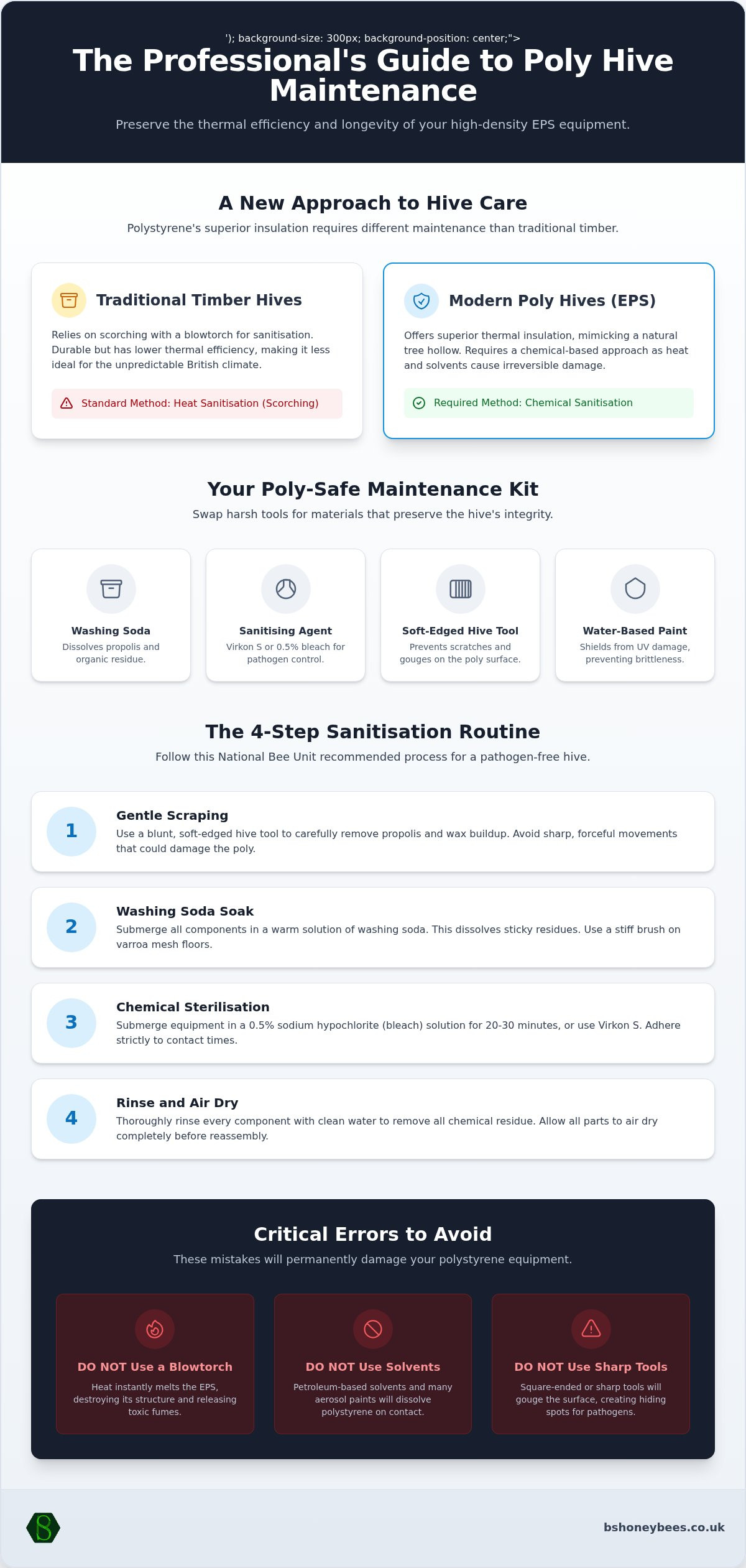
Polystyrene is remarkably tough but chemically sensitive. You cannot use a blowtorch to clear away pathogens as you would with a wooden hive. The material will melt instantly. Similarly, certain petroleum-based solvents or aerosol paints will dissolve the EPS on contact. If the surface is gouged or melted, the insulating air pockets within the material are destroyed. We define poly nuc maintenance as the preservation of high-density EPS through non-thermal cleaning and UV shielding. By avoiding high heat and harsh chemicals, you keep the hive's thermal properties intact for years of service.
Essential Tools for Your Maintenance Kit
You must swap your standard toolkit for one designed for softer materials. Leave the blowtorch in the shed. Instead, stock up on washing soda for general cleaning and Virkon S for professional-grade sanitisation. These chemicals effectively kill pathogens without degrading the EPS. Use a hive tool with rounded or soft edges. Sharp, square-ended tools are likely to gouge the textured poly surface, creating pockets where bacteria can hide. Finally, ensure you have a tin of high-quality, water-based masonry paint. This provides a vital shield against UV degradation, which can eventually turn the surface of an unpainted nuc into a powdery, brittle mess.
Cleaning and Sanitising Guide for Polystyrene Hives
A thorough deep clean is the foundation of any effective poly nuc maintenance guide. Before you begin, ensure you've removed all bees and frames to a temporary holding box. Working on empty equipment allows you to reach every corner without risking the colony's health. Start by using a blunt hive tool to gently scrape away excess propolis and wax. Avoid sharp edges that might slice into the EPS; focus on a steady, dragging motion to clear the surfaces whilst keeping the material's protective skin intact.
Prepare a warm solution of washing soda (sodium carbonate) in a large tub. This is the gold standard for dissolving organic residue and sticky propolis. Submerge the nuc body, the roof, and especially the mesh floor. The mesh floor often harbours debris and mites, so use a stiff brush to scrub the wire thoroughly. Don't forget the feeder sections; sugar syrup residue can quickly lead to mould if left unchecked. Once the organic material is gone, rinse every component with clean water and leave them to air dry completely. If you're looking to upgrade your setup before the next flow, consider the professional-grade 2-in-1 poly nucs used by specialist breeders.
Chemical Sterilisation vs. Heat
You must never use a blowtorch on a poly nuc. Heat will cause the polystyrene to melt or release toxic fumes instantly. For professional sterilisation, the National Bee Unit recommends submerging equipment in a 0.5% sodium hypochlorite (bleach) solution for twenty to thirty minutes. Alternatively, Virkon S is highly effective against pathogens like European Foulbrood (EFB). Ensure you follow the correct contact times; a quick splash isn't enough to guarantee a pathogen-free environment for your bees.
Managing Propolis and Wax Buildup
Frame rests and entrances are notorious for propolis accumulation. If these areas become heavily encrusted, it makes future inspections difficult and can lead to accidental damage during frame removal. We recommend fitting plastic frame runners to your nucs. These protect the vulnerable poly edges from hive tool damage and make scraping much smoother. Implementing a light cleaning routine at the end of each season prevents the need for aggressive scrubbing later. Clean equipment isn't just about aesthetics; it's about maintaining the precision fit of the components that ensures maximum thermal efficiency.
Seasonal Inspections: Managing Thermal Efficiency and Ventilation
Maintaining the structural integrity of your equipment is a year-round commitment. Whilst poly nucs are exceptionally durable, their lightweight nature and specific thermal properties require targeted seasonal checks. Conduct a thorough inspection of every unit during your spring and autumn management routines. This proactive approach ensures that the hive continues to function as a high-performance thermal envelope rather than just a plastic box. Use this poly nuc maintenance guide to verify the critical components that regulate the internal environment.
- Inspect the varroa mesh floor: Remove any wax cappings, propolis, or dead bees that could obstruct ventilation and harbour wax moth larvae.
- Confirm the roof fit: Ensure the lid sits flush against the nuc body to maintain the 'chimney effect' which is vital for moisture control during damp UK winters.
- Examine the entrance block: Check for a secure, tight fit to prevent rodents or wasps from entering whilst ensuring the bees have clear passage.
- Test integrated feeders: Look for hairline cracks or debris that could cause leaks or contamination of winter stores.
Autumn: Preparing for the UK Winter
UK winters are notoriously wet and windy. High winds can easily flip an unweighted poly nuc, especially when the colony is light on stores. Always use heavy-duty straps or weighted bricks to secure your equipment. Check every seam and joint for gaps. Even a tiny crack can cause significant heat loss, forcing the cluster to consume stores faster to stay warm. This level of care is essential to protect your investment in F1 Buckfast queens UK, ensuring they have the stable environment needed to survive until the first forage of the 2026 season.
Spring: Post-Winter Refresh
The first spring inspection is the time to assess how the material handled the frost and rain. You might find a small amount of surface mould on the internal walls if ventilation was restricted over winter. Wipe this away with a weak washing soda solution to give the colony a clean start. Assess the exterior paint carefully. If you notice any chalking or fading, it indicates the UV shield is weakening. A quick refresh with water-based masonry paint now will prevent the EPS from becoming brittle during the intense summer sun. Cleaning the floor at this stage assists the bees by removing the burden of house-cleaning, allowing the colony to focus entirely on rapid spring buildup.
Long-term Care: Painting and Repairing Your Poly Equipment
Painting your polystyrene equipment is far more than a simple aesthetic choice; it is a critical requirement for the material's survival. Whilst high-density EPS is structurally robust, it is highly susceptible to ultraviolet (UV) degradation. Without a protective coating, the sun's rays break down the surface of the nuc, causing it to become yellow, brittle, and eventually powdery. This breakdown compromises the thermal efficiency we discussed in earlier sections. Integrating a painting schedule into your poly nuc maintenance guide is the most effective way to extend the lifespan of your apiary hardware to a decade or more.
Your choice of colour also plays a functional role in colony management. Light shades such as pale greens, soft blues, and greys are ideal for the UK climate. These colours provide enough heat absorption to assist the cluster during a cold spring whilst preventing the hive from overheating during a summer heatwave. Furthermore, using different colours amongst your nucs helps bees with orientation, significantly reducing the risk of 'drifting' where foragers or returning queens enter the wrong hive. If you are expanding your apiary, ensure you have a consistent supply of high-quality British National Hives & Frames to maintain a professional standard across your site.
The Best Paints for Polystyrene Hives
You must exercise extreme caution when selecting your paint. Never use solvent-based or oil-based paints; the chemicals in these products will react with the polystyrene and melt the hive body on contact. Only use water-based exterior masonry paints. These products are bee-safe once dry and provide a flexible, breathable shield that moves with the material. We recommend applying at least two coats of exterior masonry paint for maximum longevity and UV protection. Ensure the nuc is completely dry and free of any wax or propolis residue before you begin the first coat to ensure proper adhesion.
Repairing Dents and Cracks
Accidents happen in the apiary. Whether it is a dropped roof or damage from a persistent woodpecker, polystyrene is susceptible to physical impact. Minor dents don't usually affect the hive's performance, but deep cracks must be sealed to prevent heat loss. Use only poly-safe adhesives or specialized fillers designed for EPS. Standard wood fillers or epoxy resins may contain solvents that cause further damage. For high-wear areas like the corners where you leverage your hive tool, consider reinforcing the edges with plastic runners or a thicker layer of paint. If a nuc has suffered severe structural failure or has become heavily porous through age, it is beyond repair. At this stage, it is safer for the colony to recycle the unit and replace it with fresh equipment to maintain your biosecurity standards.
Maximising Colony Success with BS Honey Bees Ltd 2-in-1 Poly Nucs
The 2-in-1 system from BS Honey Bees Ltd represents a significant advancement in modern apiary management. It allows beekeepers to house two separate colonies within a single footprint, which is particularly beneficial for overwintering small nuclei in the UK. This design is fully compatible with the British National beehive standard, ensuring it integrates seamlessly into existing apiaries. To get the most out of this hardware, your poly nuc maintenance guide must include specific checks for this multi-colony configuration. Proper care ensures that the shared thermal benefits are maximised, providing a stable environment for high-quality honey bee nucs for sale UK.
The central divider is the most critical component of the 2-in-1 design. If propolis or wax is allowed to build up in the vertical grooves, the divider will not sit flush against the floor or the lid. This creates gaps that bees can exploit to move between the two compartments, often resulting in the loss of one queen. During your deep clean, use a narrow, blunt tool to clear these tracks completely. BS Honey Bees Ltd has engineered these tolerances to be precise; maintaining that clear channel is vital for colony security and queen safety.
The 2-in-1 Advantage: Maintenance for Multi-Colonies
Managing dual entrances requires a different observational skill set than standard single-colony boxes. You must ensure that both entrance blocks are in good repair and that the bees are orienting correctly to their respective sides. If the exterior paint has faded or become uniform, bees may drift, which can lead to robbing or the accidental spread of mites between the two colonies. Maintaining distinct colour markers or orientation symbols on each side of the box is a simple but effective part of your long-term maintenance strategy. It ensures each colony remains distinct and manageable.
Investing in Quality British Beekeeping
Choosing hardware from BS Honey Bees Ltd means you are benefiting from designs tested in real-world conditions across thousands of colonies. Our Gloucester-based team understands that beekeeping success depends on reliable equipment that performs under pressure. By following a structured maintenance routine, you protect your investment in elite stock and ensure your apiary remains productive year after year. High standards in equipment care lead directly to better winter survival and more productive honey seasons. Upgrade your apiary with our professional range and experience the benefits of precision-engineered polystyrene equipment.
Secure Your Apiary's Future for 2026
Proper care of your polystyrene equipment is the most effective way to ensure your colonies thrive through the damp British winter. By following this poly nuc maintenance guide, you move beyond basic beekeeping into a professional standard of apiary management that prioritises colony health and equipment longevity. Remember that chemical sanitisation must always replace the blowtorch; consistent UV protection through masonry paint preserves the critical thermal properties of your high-density EPS.
Our hardware is designed for full British National frame compatibility and is the same equipment trusted by specialist breeders for managing elite Buckfast and Carniolan bees. High-density EPS provides the superior overwintering performance required for the UK climate, but it requires your commitment to a disciplined maintenance routine. Commit to these standards now to protect your investment and see the results in a stronger, more resilient spring buildup.
Shop our range of professional 2-in-1 Poly Nucs for nationwide delivery and upgrade your apiary with hardware built for performance. We look forward to supporting your beekeeping success throughout the coming season.
Frequently Asked Questions
Can I use a blowtorch to sterilise my poly nuc?
You must never use a blowtorch on a polystyrene hive as the material will melt and release toxic fumes instantly. Unlike timber equipment that can be scorched to kill pathogens, poly equipment requires chemical sanitisation. Follow a professional poly nuc maintenance guide by using Virkon S or a washing soda solution to ensure your hive is pathogen-free without compromising the structural integrity of the high-density EPS.
What is the best paint to use on a polystyrene hive?
Water-based exterior masonry paint is the best choice for protecting polystyrene hives from UV damage. Avoid any solvent-based or aerosol paints, which contain chemicals that dissolve the polystyrene on contact. Applying two coats of a light-coloured masonry paint, such as pale green or blue, creates a durable shield that prevents the material from becoming brittle whilst assisting bees with hive orientation.
How long do poly nucs typically last compared to cedar?
High-density poly nucs can last for 10 to 15 years provided they are kept painted and handled with care. Whilst high-quality cedar hives can last for several decades, poly equipment offers superior thermal performance that often results in better colony survival rates. Regular maintenance, including refreshing the UV-protective paint every few seasons, is essential to match the longevity of traditional timber alternatives.
Is it necessary to paint the inside of a poly nuc?
It is not necessary or recommended to paint the internal walls of a poly nuc. The bees will naturally coat the interior with a thin layer of propolis, which provides its own antimicrobial protection and seals the surface. Painting the inside can interfere with this natural behaviour and may introduce unnecessary chemicals into the brood nest environment. Focus your efforts entirely on maintaining the exterior UV shield.
How do I remove propolis from a poly nuc without damaging it?
Use a blunt or rounded hive tool to gently scrape away large deposits of propolis whilst avoiding the textured EPS surface. For a deeper clean, soak the components in a warm solution of washing soda, which dissolves the sticky resin without the need for aggressive scrubbing. This method is a core part of any effective poly nuc maintenance guide, as it prevents gouging the material and maintains the hive's thermal efficiency.
Are poly nucs safe for bees in the summer heat?
Poly nucs are exceptionally safe and effective during the summer because the same insulation that keeps bees warm in winter also protects them from external heat. The material prevents the internal temperature from spiking during UK heatwaves, reducing the number of bees required for cooling duties. Ensure the varroa mesh floor is clear of debris to maintain adequate ventilation during the peak of the foraging season.
Can I use bleach to clean my poly nuc?
You can safely use a bleach solution to sanitise your polystyrene equipment. The National Bee Unit recommends submerging hive parts in a 0.5% sodium hypochlorite solution for twenty to thirty minutes to ensure effective sterilisation against pathogens. Always rinse the equipment thoroughly with clean water and allow it to air dry completely before returning it to use in the apiary or placing it in storage.
Do poly nucs attract more pests like wax moths or mice?
Poly nucs do not inherently attract more pests, but they are more vulnerable to physical damage if a pest gains entry. Mice can chew through the material if they find a starting point, so always use a secure entrance block during the winter. Similarly, wax moth larvae can burrow into the EPS to pupate. Maintaining strong colonies and keeping the mesh floor clean are the best defences against these common apiary pests.