Is your apiary truly prepared for the 2026 season, or are you still managing aggressive colonies and disappointing honey yields? The success of your hive doesn't happen by accident; it starts with the genetic foundation of your colony. We understand the pressure of getting it right. The anxiety of potential queen rejection, combined with confusion over F1 versus F0 genetics, often makes sourcing mated queen bees UK feel like a high-stakes gamble rather than a routine management task.
You deserve a calm, productive apiary where bees focus on foraging rather than swarming. This guide provides the expert clarity you need to select the perfect queen, whether you require the prolific nature of an F1 Buckfast or the hardy temperament of a Carniolan. You'll learn the precise steps for a seamless introduction, ensuring your new queen is accepted and ready to build a strong, healthy population. We'll cover everything from secure transit logistics to the final release, giving you the confidence to lead your colonies toward a record-breaking year with stock that is bred for docility and performance.
Key Takeaways
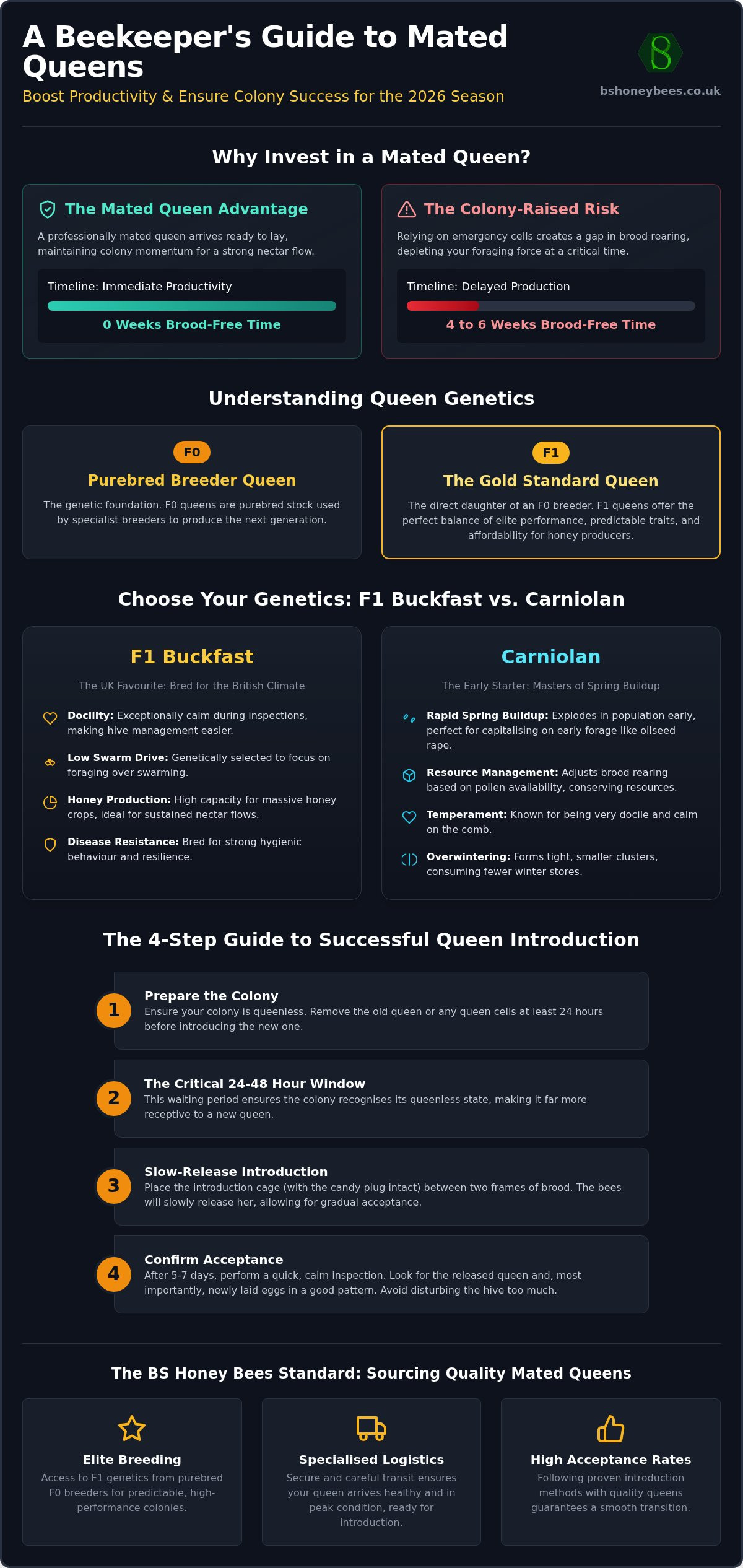
- Discover why purchasing mated queen bees UK saves up to six weeks of brood-free time and provides an immediate boost to your colony's productivity.
- Evaluate the differences between F1 Buckfast and Carniolan genetics to select a queen that matches your needs for docility or rapid spring buildup.
- Learn the essential preparation steps, including the critical 24 to 48-hour queenless window, to ensure your colony is ready for a new arrival.
- Master the step-by-step introduction process using slow-release candy cages to guarantee high acceptance rates and a calm hive.
- Understand how elite breeding agreements and specialised logistics protect your investment and ensure your bees arrive in peak condition for the 2026 season.
Why Invest in Mated Queen Bees for Your UK Apiary?
Investing in quality genetics is the most effective way to transform your beekeeping results. While a colony can technically raise its own queen, the hidden costs of this replacement are often significant. By choosing premium mated queen bees UK suppliers provide, you eliminate the high-risk waiting period that often cripples honey production. A professionally reared queen ensures your hive remains focused on foraging rather than struggling through a demographic collapse.
When a colony relies on emergency queen cells, you face a gap of four to six weeks without new brood. This interruption depletes your foraging force exactly when the nectar flow peaks. A pre-mated queen arrives ready to work, maintaining the population momentum required for a heavy honey crop. Beyond simple numbers, these queens are bred for specific, desirable traits. Professional breeding programmes focus on low swarm drive and varroa resistance, traits that make hive management significantly easier for the modern beekeeper.
Understanding Queen bee biology helps illustrate why professional mating is superior. While instrumentally inseminated queens are vital for specific breeding programmes, open-mated queens from isolated, drone-saturated apiaries typically offer better longevity and performance in the variable UK climate. They possess the natural vigour needed to lead a productive hive through a standard British season without the fragility sometimes associated with laboratory mating.
The Economic Value of a Mated Queen
The return on investment for a high-quality queen is often realised within a single season. A prolific F1 queen can dramatically increase honey yields, often producing several extra supers compared to a colony with poor genetics. This surplus easily covers the initial cost of the queen. Additionally, you mitigate the risk of mating failure. UK weather is notoriously unpredictable; a week of rain during a virgin queen's mating window can result in a drone layer or a total colony loss. A mated queen is a biologically proven, egg-laying leader ready for immediate colony integration.
F1 vs F0: Understanding the Generations
Genetics are categorised by generations to help beekeepers choose the right stock for their goals. An F0 queen is a purebred breeder queen, used primarily by specialists to produce the next generation. For most hobbyists and commercial honey producers, F1 mated queen bees UK stock represent the absolute gold standard. These are the direct daughters of an F0 breeder, offering the perfect balance of elite performance and affordability. These queens inherit essential traits like hygienic behaviour, where workers actively identify and remove diseased brood. This natural resistance is a cornerstone of modern British beekeeping, reducing the need for intensive interventions and ensuring a healthier apiary.
Choosing the Right Genetics: F1 Buckfast vs. Carniolan Queens
Selecting the right genetics is not merely a matter of preference; it is a strategic decision that dictates the rhythm of your beekeeping season. When you source mated queen bees UK breeders provide, you must weigh the traits of the F1 Buckfast against the Carniolan. Both offer exceptional docility and calm behaviour on the comb, yet they manage their resources and population growth in distinctly different ways. Your choice should depend on your local forage and your specific management goals for 2026. F1 status is vital here. It ensures you receive the predictable, high-performance traits of the parent stock without the genetic drift found in locally raised queens.
F1 Buckfast Queens: The UK Favourite
Originally developed by Brother Adam at Buckfast Abbey, these bees are specifically bred for the British climate. They are renowned for their incredible vigour and strong disease resistance. For beekeepers who value a "no-nonsense" bee, the F1 Buckfast is the ideal choice. They remain remarkably calm during inspections, often staying put on the frames whilst you work. This docility makes them a favourite amongst those who want to focus on colony management without the distraction of aggressive behaviour. Their low swarm drive and capacity for massive honey crops make them particularly effective in areas with heavy, sustained nectar flows. For a deeper look at this lineage, read our F1 Buckfast Queens UK: The Ultimate Guide to the 2026 Beekeeping Season.
Carniolan Queens: The Early Starters
If your apiary is situated in an area with strong early-season flows, such as oilseed rape or fruit blossom, Carniolan queens are an excellent investment. These bees are famous for their explosive spring buildup. They manage their population with surgical precision, rapidly increasing brood production when pollen becomes available and shutting it down just as quickly during lean periods. This sensitivity to the environment allows them to overwinter on minimal stores, making them incredibly efficient. They are the specialists of the early season, ensuring your colony is at peak strength before other breeds have even started their expansion. To help you decide, explore our comparison of Buckfast vs Carniolan Bees: Which Breed is Best for UK Beekeeping?.
Choosing between these two depends largely on your forage landscape. Buckfasts excel when there is a steady supply of nectar to support their large, prolific brood nests. Carniolans are better suited to environments where forage is intermittent or where a harsh winter requires a more frugal colony. Regardless of your choice, ensure you source your stock from a reputable breeder. You can view our current availability of high-quality queens to secure your preferred genetics for the upcoming season. Both breeds provide the hygienic behaviour and temperament needed for a successful, stress-free apiary.
How to Prepare Your Colony for a New Mated Queen
Preparing your colony is the most critical phase of the requeening process. If the hive isn't truly ready, your workers will treat a new arrival as an intruder rather than a saviour. Confirming queenlessness is the single most important step you will take. This requires more than a cursory glance at the frames. You must perform a thorough "shake and check" of every single frame in the brood box. By shaking the bees off the comb, you reveal hidden queen cells that are often tucked away in corners or behind clusters of workers. Missing even one cell can lead to the immediate rejection of your mated queen bees UK investment.
Colony temperament also plays a significant role in acceptance. A hive that has been queenless for a long period can become defensive and hostile. Dealing with a high-stress colony requires patience and precision. If the bees are running on the combs or "roaring," they are showing classic signs of queenlessness, but they are also in a state of high alert. Your goal is to move them from this state of agitation to one of acceptance by following a disciplined timeline and ensuring no internal competition exists from virgin queens or developing cells.
Dealing with Laying Workers
A colony that has been without a queen for several weeks may develop laying workers. You can identify this by looking for multiple eggs haphazardly placed in a single cell, often stuck to the sides rather than the base. You will also notice "bumpy" drone brood in worker-sized cells. Never introduce an expensive mated queen directly to a colony with laying workers. The workers already believe they are queen-right and will likely kill the newcomer. To rectify this, you must either shake the bees out several yards away from the apiary or combine the colony with a strong, queen-right nuc to reset the pheromone balance.
The "Queenless Window" Strategy
Timing your introduction is essential for success. Ideally, the colony should be queenless for 24 to 48 hours before the new queen arrives. This 24-hour mark is the "sweet spot" for acceptance; it is long enough for the old queen's pheromones to dissipate, but not so long that the bees become desperate or start developing laying workers. Be mindful that bees often start "scrub" queen cells overnight. Always check for these emergency cells one last time before placing the introduction cage. If you are ever in doubt about the hive's status, insert a test frame of unsealed brood from another colony. If the bees start building queen cells on that frame within 24 hours, you have confirmed they are definitely queenless and ready for your mated queen bees UK stock.
The Step-by-Step Guide to Successful Queen Introduction
The arrival of your new queen is a pivotal moment for your apiary. When you receive mated queen bees UK orders via Royal Mail Special Delivery, your first task is a quick but thorough inspection. Check the cage immediately to ensure the queen and her attendants are lively and active. If you notice any issues, document them straight away, but usually, you will find a healthy queen ready for her new role. Successful introduction relies on a slow, pheromone-led transition that allows the colony to accept her as their own leader.
When you are ready to head to the apiary, ensure you have already confirmed the hive is queenless as discussed in previous sections. Gently smoke the colony and move to the centre of the brood nest. Suspend the introduction cage between two frames of capped brood. This placement is vital because the emerging bees are the most accepting of a new queen, and the capped brood provides the consistent warmth she needs to remain healthy during the transition period.
Handling the Queen Cage
If weather conditions or personal schedules prevent immediate introduction, you must care for the queen properly. Keep the cage in a dark, room-temperature location away from direct sunlight or draughts. A single drop of water placed on the mesh allows the queen and her attendants to hydrate whilst they wait. When placing the cage into the hive, always ensure the candy end is facing upwards or positioned horizontally. This prevents any attendants that may perish during transit from falling and blocking the exit hole, which would trap the queen inside.
To start the release, remove the plastic tab or cap covering the candy plug. This initiates the slow-release process. The workers will gradually eat through the professional candy over 24 to 48 hours. This timeframe is essential; it provides enough time for the queen's pheromones to saturate the hive before the bees finally make physical contact with her. You can order your mated queen bees with confidence, knowing they are supplied in these specialised slow-release cages designed for maximum safety.
The Critical 7-Day Wait
Patience is the "Golden Rule" of beekeeping. Once the cage is in place and the tab is removed, close the hive and leave it alone for at least seven days. Curiosity often leads to failure. If you disturb the colony too soon, the bees may "ball" the queen. This is a defensive behaviour where they cluster tightly around her and vibrate their flight muscles to kill her through overheating. They do this because they still perceive her as a foreign intruder rather than their queen.
After a full week has passed, perform a brief inspection. Your goal is to confirm the cage is empty and to look for the first pearly white eggs in the cells. If the queen is still in the cage after three days, you may gently clear a small path through the candy with a clean nail, but only if the workers are behaving calmly and attempting to feed her through the mesh. If they are biting at the cage, they need more time.
Sourcing Quality Mated Queens in the UK: The BS Honey Bees Standard
Sourcing a queen is a critical investment in your apiary's future. At BS Honey Bees, we don't settle for average genetics. We operate under exclusive breeding agreements that allow us to provide F1 Buckfast and Carniolan stock you simply won't find elsewhere. These agreements focus on the traits that matter most to British beekeepers: docility, high honey yields, and exceptional hygienic behaviour. When you choose mated queen bees UK from our specialist stock, you're choosing bees that have been bred for performance and ease of management.
Logistics are just as vital as genetics. We understand the anxiety associated with live bee transit. That's why we use Royal Mail Special Delivery and Tracked 24 options to ensure your queen arrives in peak condition. Every queen is supplied in a professional candy cage and is marked with a premium disc marker. For the 2026 season, the international marking colour is white. This clear identification makes it easy to spot your queen during routine inspections, even in a crowded brood box.
Advanced Stock Control for Beekeepers
We've invested in an advanced real-time stock control system to give you total peace of mind. This system prevents overselling, so when you place an order, that queen is physically reserved for you. You have the flexibility to select specific dispatch dates that align with your apiary schedule, ensuring you're ready for her arrival. If you'd rather avoid the post, we offer collection options from our Gloucester base. This allows you to meet the team and transport your bees home yourself whilst receiving expert advice on the best introduction practices.
Complete Apiary Support
Our commitment to your success extends beyond the queen cage. We provide a full range of support, from detailed video guides to professional-grade BBWear bee suits. If you're looking to expand your apiary further, you might also consider our Honey Bee Nucs for Sale UK: The Complete 2026 Buyer’s Guide. We also supply British National hives and frames, ensuring your new queen has a standard, high-quality home to lead. Don't leave your 2026 season to chance. Secure your 2026 Mated Queen Bee today and experience the difference that professional breeding and logistics make to your beekeeping.
Secure Your Apiary's Success for 2026
Success in the apiary is the direct result of disciplined management and elite genetics. By mastering the selection and introduction process, you move from reactive beekeeping to proactive colony growth. You now have the expertise to identify the right breed for your local forage and the precision required to navigate the critical first week of introduction. These steps are the foundation of a calm, productive hive that is built to thrive through the British winter and excel during the spring nectar flow.
When you source mated queen bees UK stock from an industry leader, you remove the guesswork from your season. We take pride in being the UK’s #1 Retailer of Queen Bees, providing premium F1 genetics in professional candy cages with high-visibility disc markers included as standard. With Next Day Delivery available seven days a week, we ensure your queens arrive in peak condition exactly when your colony is prepared to receive them.
Order Your Premium F1 Mated Queens for the 2026 Season
Take control of your honey yields and colony temperament today. Your most successful beekeeping season yet starts with the right queen and the right partner. We look forward to supporting your apiary's growth.
Frequently Asked Questions
How long can a mated queen stay in her cage before introduction?
A mated queen can stay in her cage for up to five days if you provide proper care, though immediate introduction is always preferred. Keep the cage in a dark, quiet spot at room temperature. Place a single drop of water on the mesh daily to hydrate the queen and her attendants whilst they wait for the hive to be ready.
What is the correct way to mark a queen bee for 2026?
The international marking colour for 2026 is white. Apply a small dot of white paint or a premium disc marker specifically to the centre of the queen's thorax. This ensures she is easily identifiable amongst thousands of workers during your routine inspections, especially during heavy nectar flows when the colony population is at its peak.
What happens if the colony rejects the new queen?
Rejection often leads to "balling," where workers cluster tightly around the queen to kill her through overheating. If you witness this during an inspection, gently smoke the ball to disperse the bees and cage the queen immediately. You must then re-verify that the colony is truly queenless and wait another 48 hours before attempting a second introduction.
Do I need to remove the attendant bees from the cage before introduction?
You don't need to remove the attendant bees from the cage before placing it in the hive. Attempting to remove them significantly increases the risk of the queen flying away or being injured. Modern slow-release candy cages are designed to work perfectly with the attendants present; they will be released naturally alongside the queen.
Can I introduce a Buckfast queen to a colony of local "mongrel" bees?
You can certainly introduce a Buckfast queen to a colony of local bees. The pheromone transition takes place over the first week. As the original workers reach the end of their lifespans, they are replaced by the calmer, more productive Buckfast offspring. Within six to eight weeks, the entire colony's temperament will reflect the new genetics.
How do I know if my queen was successfully mated?
A successfully mated queen is identified by her brood laying pattern. Look for a solid, concentric area of flat-capped worker brood. If you see domed cappings in worker cells or multiple eggs per cell, she may be a drone layer or the colony may have developed laying workers as discussed in previous sections.
Is it safe to have queen bees delivered through the post?
It's very safe to have queens delivered through the post when using specialised services like Royal Mail Special Delivery. These packages are handled with priority to ensure minimal time in transit. Professional transit cages provide enough candy to sustain the queen and her attendants for the duration of the journey across the UK.
What is the best time of year to buy a mated queen in the UK?
The best time to buy mated queen bees UK stock is between May and August. This period ensures the queens were mated during peak drone saturation and that the weather is warm enough for a successful introduction. Early season queens are ideal for requeening struggling colonies, whilst late summer queens are perfect for preparing hives for successful overwintering.